
Quick Take
Determining whether your business needs an external HR consultant vs. an internal HR manager isn’t always dependent on how many employees you have. Instead, it’s an economical capacity decision based on operational complexity, recruitment volume and employee relations exposure.
External HR consultants are third-party specialists you can retain on an ongoing or project basis. They are ideal for small to medium businesses looking for an objective point-of-view to help build strategic systems, update compliance policies or navigate complex employee disputes without the burden of a full-time employee’s salary.
Internal HR managers are in-house organizational leaders responsible for ongoing administrative operations, cultural development and smoothing out any employee relations with timely, hands-on execution. If your people operations require immediate and dedicated oversight, your business may benefit from a full-time hire.
Many organizations find the most economical solution is to start with an HR consultant or outsourced HR provider to establish some foundational HR processes and policies. Once your volume of operations justifies it, you can make the switch to an in-house HR manager, or split the duties between a manager and consultant.
Key Takeaways
- The “HR Gap” Threatens Scaling Businesses: Companies with 15 to 50 employees often outgrow informal owner-led management but lack the continuous daily workload to justify a full-time HR manager. This gap is best filled by a retained HR consultant.
- Complexity Outweighs Headcount: A high-turnover business with 20 employees across multiple shifts and commission tiers generates significantly more HR risk than a stable, 40-person professional services firm. Headcount alone should never dictate your hiring timing.
- Proximity vs. Perspective: Internal HR managers offer immediate operational presence, cultural alignment, and continuous oversight. External consultants bring cross-industry benchmarks, objective third-party neutrality in sensitive disputes, and specialized labor expertise.
- Full-Time Overhead vs. Variable Retainers: A full-time HR manager introduces fixed payroll costs, statutory benefits, workspace overhead, and recruitment expenses. A consultant operates as a scalable operational expense (OpEx) aligned directly with immediate business demands.
- Clear Operational Boundaries: HR consultants establish compliance structures, update policies, train line managers, and audit workforce practices. Complex litigation, CCMA representation, and formal legal opinions should always be escalated to qualified labor law specialists or attorneys.
Table of Contents
The Turning Point in People Operations

Defining the Roles: Strategic Differences

The Invisible "HR Gap" in SME Growth

Direct Comparison: Cost, Utilization, and Operational Scope

Scenarios: Evaluating Four Business Stages

Why Headcount Is a Flawed Hiring Benchmark

When Hiring an HR Manager Too Early Fails

When Over-Relying on a Consultant Stalls Growth

The Hybrid Model: Combining Internal Presence with External Expertise

8-Point Decision Framework for Business Owners

Understanding Outsourced HR Services

HR Consultant vs. Labor Attorney: Protecting Your Business

Frequently Asked Questions

Conclusion
The Turning Point in People Operations
Every business reaches a moment when casual, owner-driven HR management fails.
That tipping point seldom comes heralded by a chorus of angels. Instead, it reveals itself when direct reports flood executive management with policy inquiries, when an awkward performance discussion devolves into a grievance filing, or when a founder discovers they’re spending two days each week processing vacation requests, writing employment agreements, and screening job candidates instead of growing sales.
The Three Phases of People Operations: How HR Evolves as You Scale
Human Resources isn’t something you flip on or off like a light switch. It’s an evolutionary process that changes dramatically as your company grows. When you scale your business from a tight-knit group of founders to a mature organization, your needs for people management will transition through three phases.
Recognizing which phase your business is in along this continuum will help you know when and where to allocate your HR efforts and resources — without overspending on permanent overhead or leaving your company open to risk.
Phase 1: Informal HR (0 – 15 Employees)
During the seed stage of a business, human resources is almost never a stand-alone function. Someone handles people-related tasks, but it’s likely the founder, managing director, or office administrator who does so in addition to their core job responsibilities.
- Primary Operational Traits:
- Owner-led administration: The business owner handles hiring interviews, setting salaries, and addressing interpersonal issues directly.
- Basic contract structures: Employment agreements rely on standard templates, often missing role-specific clauses, strict confidentiality provisions, or tailored restraint-of-trade terms.
- Ad-hoc policies: Rules regarding remote work, leave requests, and performance expectations exist as informal verbal agreements or unwritten workplace norms.
The Strategic Reality: At this size, informal HR works because communication channels are short and direct. However, because policies are undocumented, the business begins accumulating hidden compliance vulnerabilities that surface as soon as the team expands.
Phase 2: The HR Gap (15 – 50 Employees) — The HR Consultant Zone
When you grow beyond ~15 employees, however, informal practices start to break down. The owner doesn’t have first-hand knowledge of what’s happening with every employee on a day-to-day basis, and you begin to hire managers to run sub-teams. It’s at this stage where you find yourself in The HR Gap.
The “HR Gap” Challenges
Retention Challenges
Top performers leave due to unclear career progression or inconsistent appraisals.
Line Manager Friction
Newly promoted managers lack training to handle poor performance or employee grievances.
Compliance Exposure
Outdated contracts and informal discipline create serious legal risk in labor disputes.
- Why This Is the “HR Consultant Zone”: Hiring a full-time HR manager at Phase 2 is often premature—they will quickly run out of daily task volume and spend time on administrative filler. Conversely, expecting the owner or line managers to handle escalating disputes leads to legal mistakes and leadership burnout.
- Partnering with an external HR consultant or retained HR service bridges this exact gap. It gives the organization instant access to senior-level expertise, compliant contracts, structured performance management frameworks, and objective dispute resolution—paying strictly for the strategic capacity needed without adding fixed payroll overhead.
Phase 3: Embedded HR (50+ Employees)
Once an organization scales past 50 employees, human resources transitions from a periodic strategic need into a continuous daily operational function.
- Primary Operational Traits:
- Dedicated HR Department: The company hires a full-time internal HR Manager (and eventually junior HR coordinators or talent acquisition specialists).
- Scaled Recruitment Pipelines: Talent acquisition becomes an ongoing operation rather than an occasional project, requiring dedicated applicant tracking and onboarding workflows.
- Strategic Workforce Planning: HR collaborates directly with executive leadership on long-term organizational design, succession planning, compensation structuring, and culture preservation.
- The Strategic Reality: At Phase 3, an embedded HR manager becomes essential to maintain daily operational momentum, support line managers on-site, and preserve company culture across multiple departments.
Reaching this point, business leaders often make the assumption that they need to hire “An HR Manager.”
Prematurely staffing your organization with a dedicated full-time HR manager can create excess capacity and unnecessary overhead. In many cases, working with an HR consultant can offer your company strategic guidance, compliance requirements and process architecture for a fraction of the price.
How do you know which option is best for you? Don’t hire based on titles. Analyze your companies operations, growth rate and internal capability.
Defining the Roles: Strategic Differences
To make an informed decision, you must first understand how an external consultant and an internal manager function within a business architecture.
Defining the Roles & Operational Fit
External HR Consultant
- Structure: Independent practitioner or specialized firm on retainer.
- Focus: System design, compliance audits, objective dispute resolution.
- Perspective: Unbiased third-party insights benchmarked across industries.
- Engagement: Project-based, hourly, or fixed monthly service-level model.
Internal HR Manager
- Structure: Permanent, full-time salaried employee embedded on-site.
- Focus: Daily administrative execution, culture, candidate pipelines.
- Perspective: Deep internal understanding of team dynamics and politics.
- Engagement: Continuous, full-time presence integrated into leadership.
An HR Consultant
A HR consultant works for themselves. They advise you, build your HR framework from scratch, update you on legal updates and help you navigate tricky HR situations.
You may hire a consultant to do an in-depth HR review, create tailor-made employment agreements, set up appraisal processes, conduct disciplinary proceedings, or assist with organizational change. Consultants are most valuable for project implementation, niche expertise and unbiased perspective.
An HR Manager
An HR manager works for you. They manage your internal HR department. An HR manager will process new hires, update employee files electronically, address everyday employee complaints, manage development opportunities, ensure employees are following rules and regulations, and be there for your managers.
They are most valuable because they are readily available, closely aligned with your company and involved in the everyday happenings.
The Invisible “HR Gap” in SME Growth
The most challenging operational phase for small to medium-sized enterprises occurs within the HR Gap—the organizational stage where a company has clearly outgrown basic informal practices, but lacks the daily workload required to justify a full-time, salaried HR manager.
The SME “HR Gap”
Too complex for informal owner administration
Unmanaged compliance risk, informal dispute resolution, & retention leakage
Insufficient daily workload for a full-time 40-hour/week HR Manager
Let’s say you have a company of 25 staff. You have ongoing recruiting needs, periodic performance issues, changing contract requirements and line managers who need support and direction on how to manage and enforce policy.
If the owner tries to manage all of this, then valuable leadership time is spent away from focusing on the business and strategy. If you hire a full-time HR person, that person will realistically only spend about 10-15 hours per week doing “real” HR work. You are left with an employee that is under utilized and draining your fixed budget.
Hiring a retained HR consultant or outsourcing your HR needs fills that void. You gain access to executive-level HR experience, compliant paperwork and management direction when you need it – without adding permanent payroll.
Direct Comparison: Cost, Utilization, and Operational Scope
Comparing an external consultant’s invoice against an internal manager’s base salary often leads to inaccurate conclusions. A permanent employee introduces additional financial commitments beyond their base pay, whereas a consultant converts fixed payroll into a flexible, controlled operational expense.
| Decision Factor | External HR Consultant | Internal HR Manager |
| Financial Structure | Variable operational expense (monthly retainer, project fee, or hourly rate). | Fixed payroll commitment (base salary plus statutory benefits, bonuses, and leave). |
| Overhead Commitments | Zero workspace, equipment, software license, or benefit costs. | Full hardware, software, office space, and ongoing training support required. |
| Capacity Utilization | Scalable on demand; you pay strictly for required hours, audits, or deliverables. | Fixed at 40 hours per week, regardless of operational workload fluctuations. |
| Company & Cultural Depth | External view; requires context building during each engagement. | Fully embedded; understands internal team dynamics, history, and culture. |
| Objectivity & Neutrality | Unbiased third-party stance; ideal for sensitive disputes or audits. | Susceptible to internal office politics and management biases over time. |
| Specialization & Breadth | High; draws from broad experience across diverse client portfolios. | Variable; shaped by the specific background of the individual hire. |
| Speed of Daily Execution | Scheduled response windows based on agreed Service Level Agreements (SLAs). | Immediate on-site response for daily employee requests and issues. |
Scenarios: Evaluating Four Business Stages
To illustrate how HR requirements evolve as companies expand, consider these four realistic operational scenarios:
| Scenario | Staff Count | HR Operating Model | Key Services & Support Provided |
| Scenario 1 | 10 Staff | Project Consultant | Basic documentation & ad-hoc advisory support. |
| Scenario 2 | 25 Staff | Retained Consultant | System standardization & line manager leadership training. |
| Scenario 3 | 75 Staff | Embedded HR Manager | In-house operational manager backed by external specialist support. |
| Scenario 4 | 200+ Staff | Multi-Person HR Department | Dedicated in-house team supported by an external advisory board. |
Scenario 1: The Early-Stage Business (10 Employees)
- Operational Reality: Hiring occurs once or twice a year. The core team is stable, and personnel friction is minimal. The business owner manages operations directly.
- HR Requirement: Standardized employment contracts, baseline compliance policies, and an on-call specialist for occasional disciplinary advice.
- Optimal Model: Project-Based HR Consultant. Hiring an internal manager at this stage creates unnecessary overhead. An external consultant can set up foundational contract templates and policy handbooks in expending minimal capital.
Scenario 2: The Accelerating SME (25 Employees)
- Operational Reality: The company is adding staff quarterly across three distinct teams led by newly promoted line managers. Employee performance variations and policy questions are becoming frequent.
- HR Requirement: Structured onboarding processes, formal performance management frameworks, line-manager guidance, and regular compliance oversight.
- Optimal Model: Retained HR Consultant or Outsourced HR. The company requires structured HR management, but lacks the daily workload to justify a full-time position. A retained consultant provides dedicated monthly hours to train managers, handle complex disputes, and audit compliance systems.
Scenario 3: The Established Mid-Sized Business (75 Employees)
- Operational Reality: Recruitment is continuous, departmental structures are defined, and daily administrative demands (leave tracking, onboarding, grievance management) consume significant time.
- HR Requirement: Daily on-site presence, real-time employee support, active recruitment pipeline management, and continuous alignment with company culture.
- Optimal Model: Dedicated Internal HR Manager. At this scale, human resources is a continuous daily operation. An embedded manager handles daily workflows, while an external consultant remains on call to assist with complex litigation or independent audits.
Scenario 4: The Complex Enterprise (200+ Employees)
- Operational Reality: Multi-site operations, matrix management layers, continuous talent acquisition needs, and complex regulatory reporting requirements.
- HR Requirement: A specialized internal human resources department supported by dedicated software infrastructure.
- Optimal Model: Internal HR Department + Specialist External Consultants. The internal team manages daily operations, organizational development, and recruitment. External consultants are brought in for independent executive assessments, large-scale restructurings, or specialized compliance reviews.
Why Headcount Is a Flawed Hiring Benchmark
One mistake that leaders make is tying their need for an internal HR professional solely to headcount. Complexity of operations, industry factors and turnover influence your HR demands much more than headcount alone.
HR Consultant
- HR Systems & Process Design
- Contract Architecture & Review
- Policy Implementation
- Disciplinary & Compliance Audits
Labor Attorney
- Labour Court & High Court Representation
- High-Risk CCMA / Arbitration Trials
- Formal Legal Opinions
- Strike Interdicts & Injunctions
Here are some factors of business complexity to consider in addition to headcount:
- Turnover Rate: Having two hard to fill positions open annually will allow you to operate with much less capacity than if you have an entry level sales or service team with five new employees every month.
- Schedules & Pay Structure: Do you work with salaried employees who work typical business hours from an office? Or do you have shift workers across multiple locations you need to track for overtime, allowances, hourly wages, etc. ?
- Employee Relations Demand: How heavily regulated is your industry? Do you have a higher than average employee relations situations bubbling up in the form of disciplinary actions, performance management issues, or employee grievances?
- Strength of Management: Do your managers have the experience and leadership skills to handle the day-to-day people issues? Or do you have many team leaders who are first-time managers formerly from a technical background.
When Hiring an HR Manager Too Early Fails
Hiring an HR Manager full-time prior to needing someone to stay busy eight hours per day five days per week tends to lead to some classic growing pains:
- Bored HR professional = high turnover: If someone with an HR background walks into a job to discover that fifteen hours per week is all you need to spend on processing contracts and basic HR admin, they will become bored. This usually results in them not staying with your company very long.
- Too many rules = too much process: In order to feel busy doing an eight hour day with low transaction volume, your HR manager may feel the need to create an elaborate multi-step performance review process, extensive approval matrices and lots of restrictive policies that bog down a lean entrepreneurial operation.
- Increased payroll before needed: Before your revenues can easily absorb the burden of another salary, you just added an expensive salary + workstation + software + mandatory benefit payouts to your overhead.
Observation from the field: A rapidly scaling technology company brought on a senior HR manager at 18 employees. After four months, the manager had rewritten the employee handbook 3 times and implemented a performance management system that involved weekly meetings. Engineering was frustrated by HR/admin bloat. HR manager left in frustration at not having enough “strategy” work. Company went back to using a retained outside consultant and cut their HR spending by 60%, while still having access to needed systems.
When Over-Relying on a Consultant Stalls Growth
On the other side of that coin, trying to partner with an outside consultant well beyond your growing business’s enterprise size also leads to operational bottlenecks:
- Employee matters slow your daily operations: Requiring line managers to file a ticket or calendar time with an outside consultant just to ask questions about common employee scenarios puts a damper on day-to-day resolution. Misspellings can turn into personnel disputes while your consultant crafts a reply.
- You can’t see your culture in real time: Your consultant comes into your offices a few times a month or works remotely from their desk. They’re not sitting in on your daily operational huddle, watching office interactions, or schmoozing with staff during monthly team meetings. Without these windows into your daily operations, small cultural shifts or festering team frustration can go unnoticed until an employee quits.
- Hourly or project retainers become more expensive: Do you really need 30+ hours of hands-on HR assistance each week to keep up with your never-ending hiring, onboarding, and administrative tracking? If so, you’ll quickly out-pay an internal salary by hiring a consultant at an hourly or project rate.
The Hybrid Model: Combining Internal Presence with External Expertise
For expanding mid-sized organizations, the debate does not have to be an all-or-nothing choice. A Hybrid HR Model blends internal operational presence with specialized external guidance, providing a highly effective balance of cost control and strategic capability.
Internal HR Generalist / Junior Coordinator
- Daily Onboarding & Induction
- Administrative Personnel Records
- Leave & Payroll Tracking Support
- Workplace Culture & Event Coordination
Retained HR Consultant / Specialist Firm
- System & Policy Compliance Audits
- Complex Disciplinary Cases & Hearings
- Executive & Departmental Restructuring
- High-Risk Dispute & Labor Advisory
In this model, the company hires a Level I HR associate or generalist to work on daily operational activities such as maintaining employee files, managing onboarding calendars, and providing a familiar contact person for employees.
The company contracts with a Senior HR professional on an as-needed basis to manage strategic initiatives, perform annual legal compliance checks, advise on complicated disciplinary issues, and assist with delicate organizational changes.
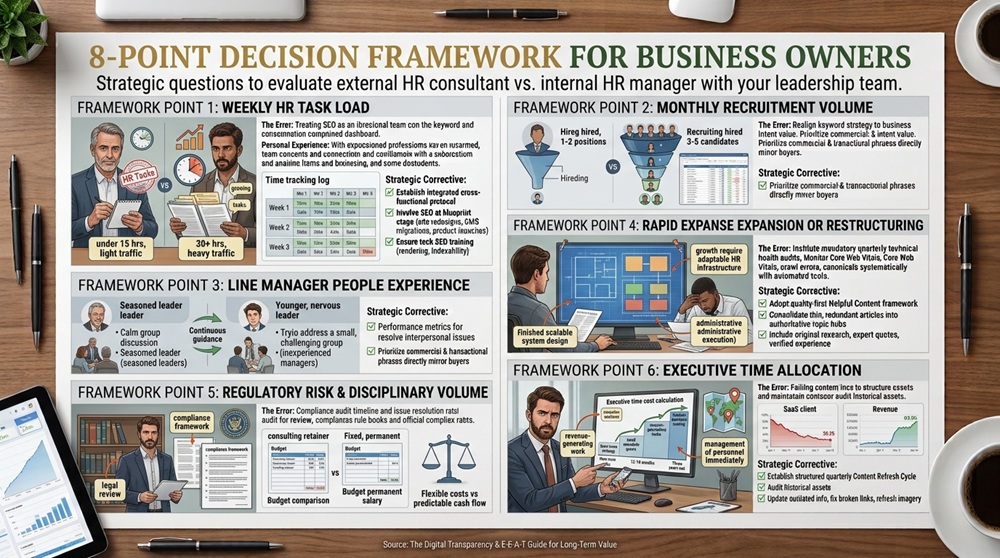
8-Point Decision Framework for Business Owners
Deciding between hiring a Human Resources consultant vs. a Human Resources manager can be difficult. Here are eight questions to ask yourself and your executives:
- How many hours per week will dedicated HR work consume? Log the time your leadership team spends on HR related work for three weeks. If it adds up to less than 15 hrs per week, you should probably favor a consultant. If it’s consistently nearing 30 hours per week, you may want to keep it in-house.
- How many new employees do you onboard each month? If it’s only one or two positions every quarter, a consultant should be able to handle your recruitment needs. If you’re regularly recruiting 3-5 new personnel each month, you’ll need someone full-time.
- How strong are your line managers when it comes to people management? If your senior managers are veteran leaders that can solve people problems on their own, a consult on-call should be enough. If your management team is green, they will need constant hands-on support.
- Is your company growing or re-structuring rapidly? Growing organizations need flexible HR support. A consultant can help you design scalable systems overnight. An internal HR manager will likely be bogged down with running those systems on a daily basis.
- How much labor compliance risk do you have? High-risk industries and high volumes of disciplinary actions require the defendable, third-party opinion of a consultant during hearings and audits.
- Are executives spending time on administrative tasks instead of revenue generating activities? If you find high caliber leadership spending too much time on basic employee requests, you need HR help yesterday. Start with a consultant to bring some immediate stability.
- How much of your operating budget is dedicated to fixed costs? If you need your expenses to be flexible with the ability to scale up and down, a consulting retainer will prevent long-term financial obligations. If you can afford an internal resource and have stable cash-flow, consider a full-time hire.
- Where will your company be in three years? Don’t build your HR infrastructure to support a size you’ll grow into. Choose HR support that will help you with your short-term growth plan for the next 12-18 months.
Understanding Outsourced HR Services
Outsourced HR offers small to medium businesses the best of both worlds between consulting projects and a full-time employee.
Instead of hiring a consultant to perform isolated tasks, an outsourced HR relationship retains an outside firm to be your full-service, off-site HR department for a monthly retainer.
Outsourced HR Service Components
Ask your outsourced HR provider about more than just their monthly fees. Inquire about their operational platform. Ask about response time guarantees. Will you receive a dedicated account consultant for your business? Find out how special cases like labor disputes or on-site visits will be managed.
HR Consultant
- HR Systems Design
- Contract Architecture
- Policy Implementation
- Disciplinary Audits
Labor Attorney
- Court Representation
- High-Risk CCMA Trials
- Formal Legal Opinions
- Strike Interdicts
HR Consultant vs. Labor Attorney: Safeguarding your Business
One of the many jobs of business owners is knowing when HR management ends and when you need to retain an attorney. HR will help develop systems, create policies, and manage your employee population. However, when you are facing a litigated matter, you will need a lawyer.
- Work with your HR Consultant to: Audit employment agreements, design performance management systems, coach your managers, implement compliant policies and procedures, preside over internal disciplinary hearings, and ensure your business is operating within compliance.
- Retain a Labor Attorney when you: Have to appear in court or high stake CCMA arbitration, need a legal opinion on complex labor law issues, or face risky labor strikes and interdicts.
By working with a knowledgeable HR consultant you can ensure your business has happy, compliant practices that limit your exposure to risk leaving you with little to no need for a lawyer.
HR FAQ’s
What’s the difference between an HR consultant and an HR Manager?
Simply, scale. HR Consultants are flexible external advisors who help you build HR systems and troubleshoot complex issues on retainer or per-project basis. HR Managers are embedded, full-time employees that handle day-to-day internal HR workflows, provide on-site support for your employees, and work tirelessly to cultivate company culture.
How do I know when my business needs to level-up from an HR consultant?
You’ve likely outgrown the assistance of an external consultant once your weekly administrative HR tasks are taking 30+ hours, you need full-time recruitment support to keep up with your hiring needs, or your managers need instant access to on-site HR support during the day to keep your staff productivity high.
Wouldn’t it be cheaper for my small business to hire an HR manager?
No. Unless you have steady HR tasks that take more than 30 hours per week, you HR consultant will almost always be cheaper option for your business. With an HR consultant, you avoid making fixed payroll investments and providing statutory benefits, software licenses, workspace, and pay only for the strategic expertise and hours you need.
What should I look for in an HR consultant for my SME?
HR experience with companies similar to yours. Look for consultants that have provided services to other small-to-midsize businesses, know the ins-and-outs of relevant labour laws, provide comprehensive service level agreements (SLAs), are transparent about when they need to refer legal issues to outside counsel, and give realistic advice that suits your business needs, not complex administrative processes that you don’t need.
Can I get my HR consultant to do internal disciplinary hearings?
A: Absolutely. Your HR consultant can act as the third-party chair of any internal disciplinary hearings. They can offer unbiased guidance and ensure your process runs smoothly.
What is meant by the “HR Gap”?
The HR Gap is the sweet spot in company growth (between 15-50 employees) where your business has outgrown having the owner(s) directly manage HR tasks, but haven’t grown to the point of having enough daily HR tasks to warrant a full-time, salaried employee. Retained HR Consultants or Outsource HR Providers are perfect for closing your HR Gap.
Closing thoughts
Figuring out if your business needs an HR consultant or HR manager is easy: Be honest with yourself about your company’s operational needs, growth plans, and your internal capacity to manage your team. If you’re reading this, you’re already past the stage of having your employees solely managed by you. Bringing in HR allows you to offload the complexities of employment legislation and allows you to scale your team with confidence.
Whether you need an HR manager or HR consultant entirely depends on your business. Bringing in an HR manager when you don’t need a full-time employee will cost you. Continuing to have your managers handle HR in-house long after you’ve outgrown that phase can leave your business non-compliant with HR legislation.
Evaluate your needs, know your managers strengths and weaknesses, and use a HR consultant to support you through your business’ growth. You’ll thank yourself when you have a compliant, high-performing team that’s built for scaling.
Next Steps
To evaluate and optimize your organization’s HR framework:
- Conduct an Operational HR Workload Assessment: Track the total hours your management team spends weekly on recruitment, contract management, policy questions, and employee disputes.
- Review Your Compliance Architecture: Ensure your employment contracts, policy handbooks, and disciplinary workflows reflect current legal standards and operational realities.
- Schedule an HR Strategy Audit: Partner with an experienced HR consultant to evaluate your people operations, identify structural compliance gaps, and build a scalable HR roadmap tailored to your growth objectives.
Unsure Whether You Need an HR Consultant or a Full-Time Manager?
Don’t over-commit your budget or leave your business exposed. Partner with Gente to get tailored, scalable HR support designed specifically for South African SMEs.
Book Your Free HR Strategy Consultation →No long-term commitments • Expert guidance on contracts, compliance & performance management






No comment